
Mission &vision
OutMARCH pioneers a new therapeutic strategy that eliminates disease-driving proteins from the cell surface rather than simply blocking them. By developing a novel class of SureTACs, bispecific antibodies that recruit membrane-bound E3 ubiquitin ligases to trigger lysosomal degradation, we aim to target previously undruggable surface proteins with greater selectivity and durability.
Beyond cancer, the OutMARCH platform has the potential to open new therapeutic opportunities in autoimmunity, transplantation, chronic inflammation, and other diseases driven by aberrant cell surface signaling. Our mission is to establish membrane protein degradation as a broadly applicable therapeutic strategy, paving the way towards programmable precision medicine.
Scientific background
Going beyond blocking strategies
Many cancers are driven by abnormal signalling through proteins located at the cell surface. These include receptors, co-receptors, immune checkpoints and larger signalling complexes that control how cells respond to growth factors, environmental signals and immune cues. When these systems become deregulated, they can support tumour growth, therapy resistance and relapse.
Most current therapies against cell-surface proteins are designed to inhibit or block their activity. This has led to important advances in cancer treatment, but blocking approaches also have limitations. They often require continuous target engagement, may not fully silence complex signalling assemblies and can be undermined by compensatory signalling or resistance mechanisms.
Some surface proteins are especially difficult to target because their function does not depend on a single enzymatic pocket or one simple ligand-binding site. Instead, they may act through scaffolding, clustering, co-receptor interactions or non-enzymatic signalling roles. For these targets, removing the protein from the cell surface may offer a fundamentally different therapeutic principle.
Targeted degradation for membrane proteins
Targeted protein degradation has expanded the idea of what can be therapeutically addressed. Instead of blocking a protein, degradation strategies aim to remove it. Many established degrader technologies work inside the cell and rely on the proteasome, which is mainly suited to intracellular proteins.
OutMARCH focuses on cell-surface and membrane-associated proteins. These proteins are naturally connected to endosomal and lysosomal trafficking routes. This makes lysosomal degradation an attractive strategy for removing disease-driving proteins from the cell surface.
MARCH-based SureTACs
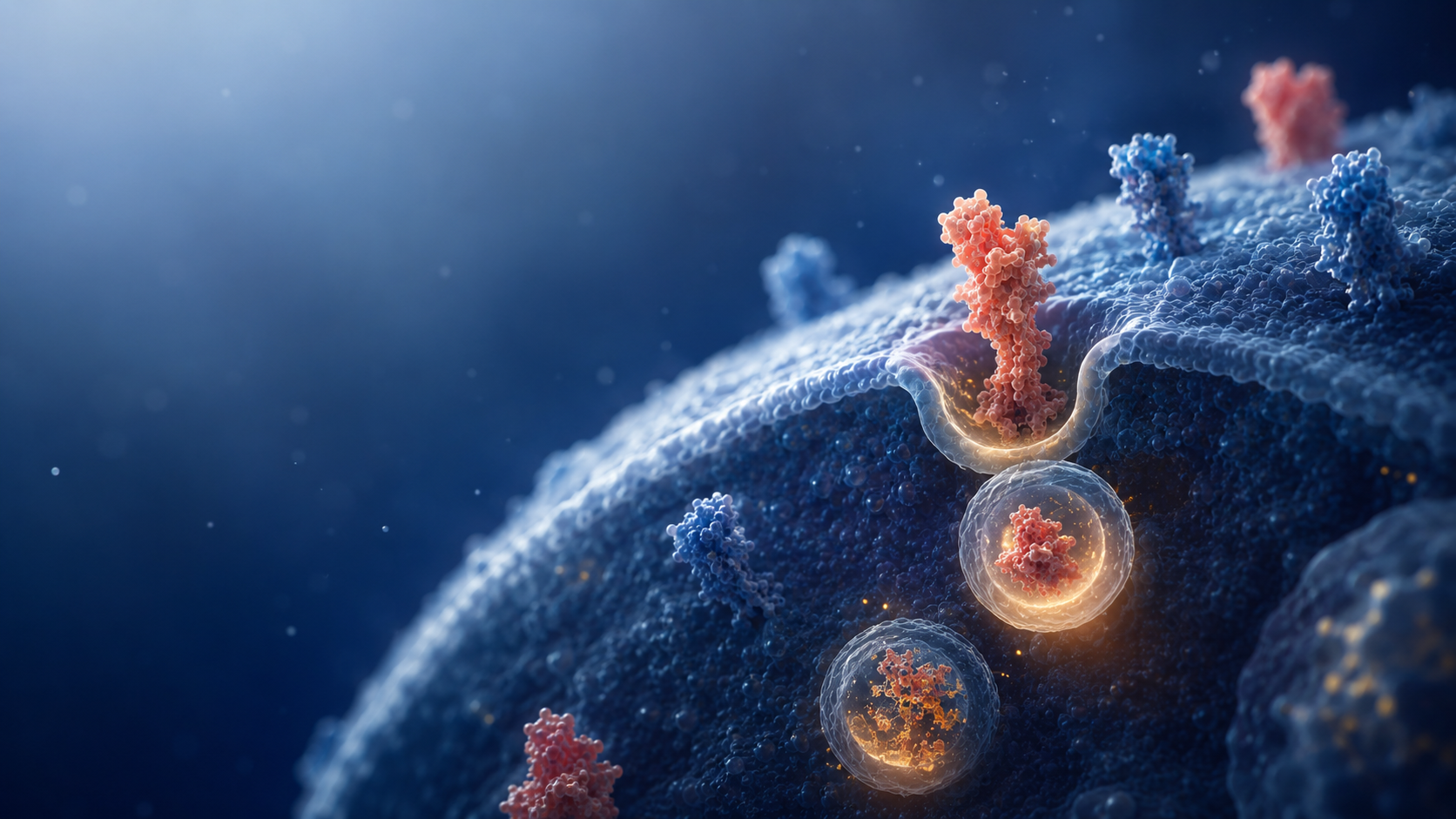
SureTACs are bispecific antibody-based degraders. One part binds a disease-driving surface protein, while the other engages a membrane-bound E3 ligase. By bringing these two proteins into close proximity, SureTACs are designed to trigger ubiquitination, internalisation and lysosomal degradation of the target.
OutMARCH builds on this principle by focusing on the MARCH family of membrane-associated E3 ligases. This is the key scientific novelty of the project. MARCH proteins have properties that make them highly interesting for targeted membrane protein degradation, including broad substrate-handling potential and selective expression patterns in certain cancer tissues.
At the same time, MARCH proteins are technically challenging targets. They are multispan membrane proteins with only small exposed regions outside the cell, making it difficult to generate binders against them using conventional antibody discovery approaches. Solving this binder challenge is central to the OutMARCH project.